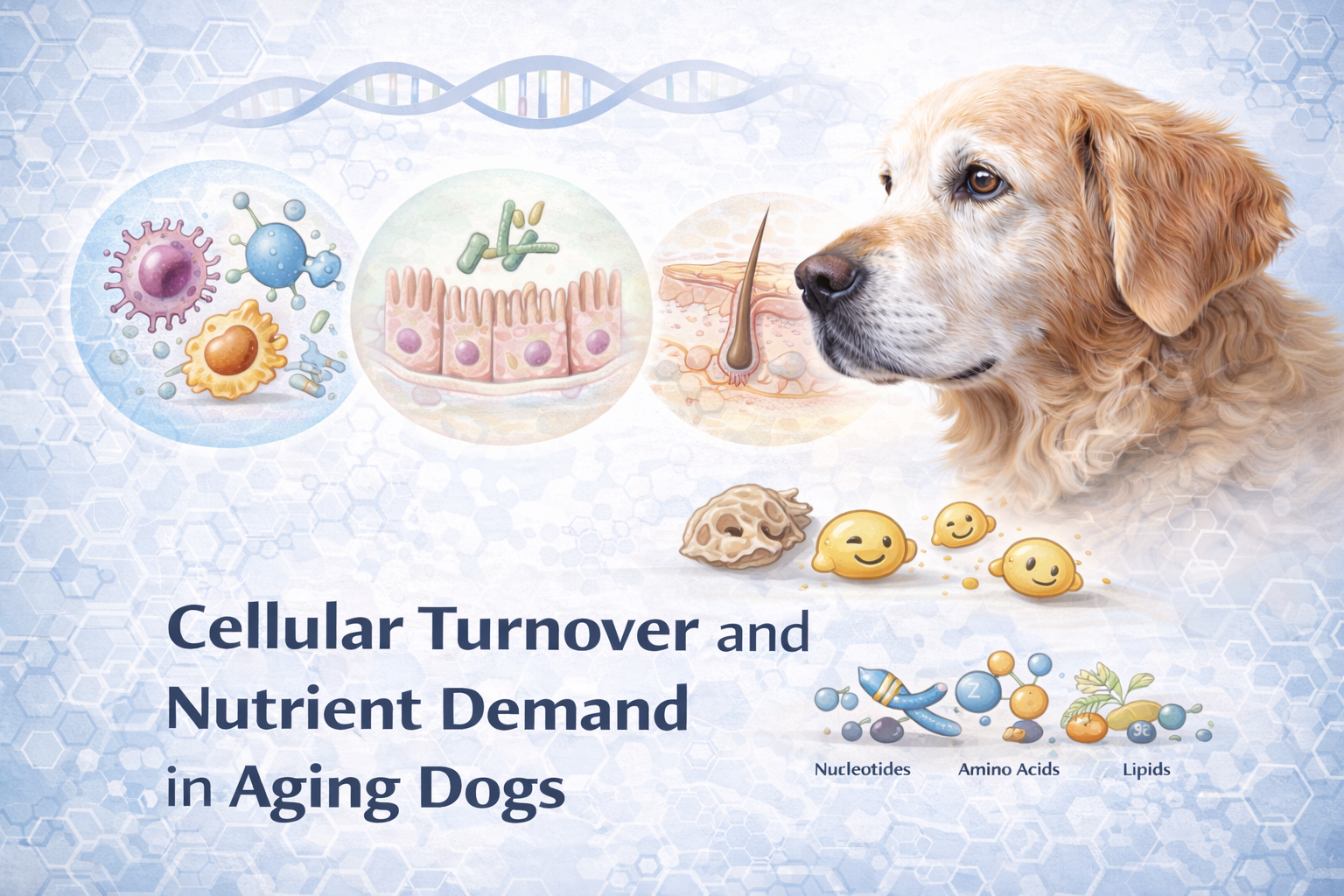

Cellular Turnover and Nutrient Demand in Aging Dogs
Individual variation between dogs — including breed, size, and environment — influences biological aging trajectories.
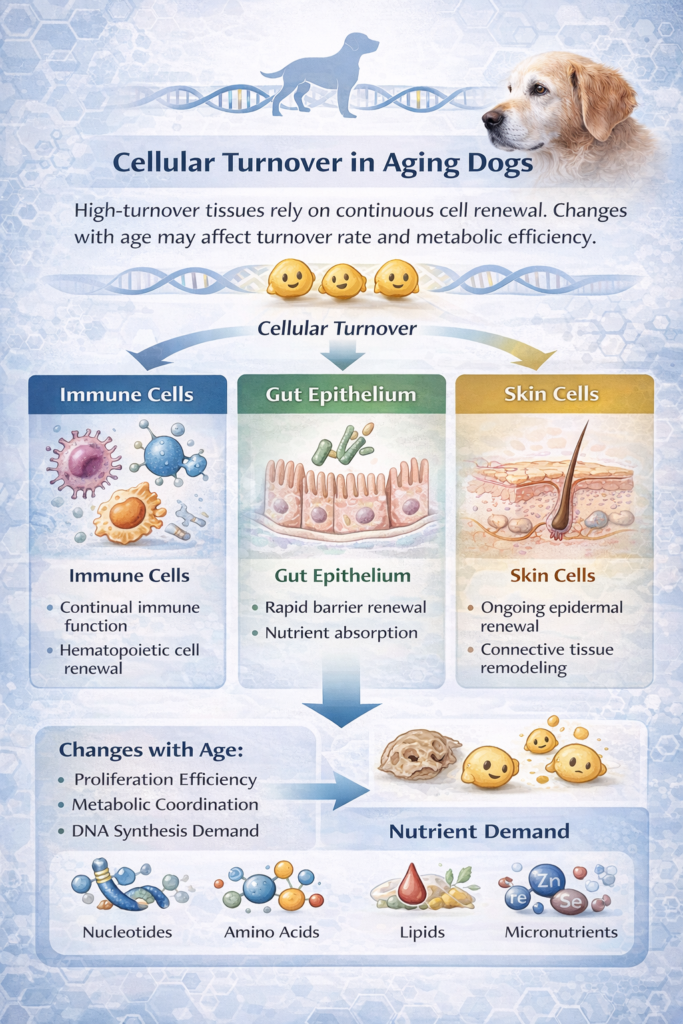
Nutrient Demand in High-Turnover Systems
Nutrient demand is not static across the lifespan. High-turnover tissues require ongoing substrate availability to sustain replication and maintenance.
Substrate availability refers to the presence of fundamental building blocks necessary for:
-
This does not imply that increased intake directly translates to improved outcomes. Rather, it underscores that cellular processes operate within biochemical constraints.
Nutritional geroscience explores how dietary components interact with these systems under defined experimental conditions. The objective is not to override genetic programming, but to understand physiological response patterns.
Distinguishing Support from Intervention
It is essential to distinguish between:
-
Nutritional strategies operate within the domain of physiological maintenance. They do not function as therapeutic agents, nor do they directly alter genetic determinants of lifespan.
High-turnover tissues are sensitive to metabolic stress, oxidative load, and environmental exposures. Nutritional adequacy contributes to maintaining normal function within these systems, but does not reverse aging processes.
Scientific clarity requires proportional interpretation.
Biomarkers in Turnover Research
Researchers studying cellular turnover in aging dogs may examine:
-
These biomarkers provide insights into biological activity within defined contexts. They do not independently establish functional outcomes or lifespan extension.
Interpreting biomarker shifts requires careful alignment with study design and methodological limitations.
Integration Within Aging Biology
Cellular turnover represents one dimension of aging biology. It interacts with:
-
Aging is multifactorial. No single parameter captures its complexity.
In companion animals, ongoing research seeks to integrate these components into coherent biological models. Nutritional inquiry contributes to this dialogue by examining how physiological systems respond under controlled dietary conditions.
Perspective
Understanding cellular turnover in aging dogs does not imply that aging can be reversed or halted. Rather, it provides insight into how tissues maintain integrity over time.
As companion animals live longer, exploring the biological context of tissue renewal becomes increasingly relevant. Responsible research in this area depends on:
-
Cellular maintenance is foundational to physiological function. Appreciating its role within aging biology is an important step in advancing comparative geroscience.
Interpretation Statement
Observations regarding cellular turnover and nutrient demand reflect biological associations within defined research contexts. These findings do not independently demonstrate lifespan extension, disease prevention, or therapeutic outcomes. Interpretation must remain aligned with study design and evidentiary scope.