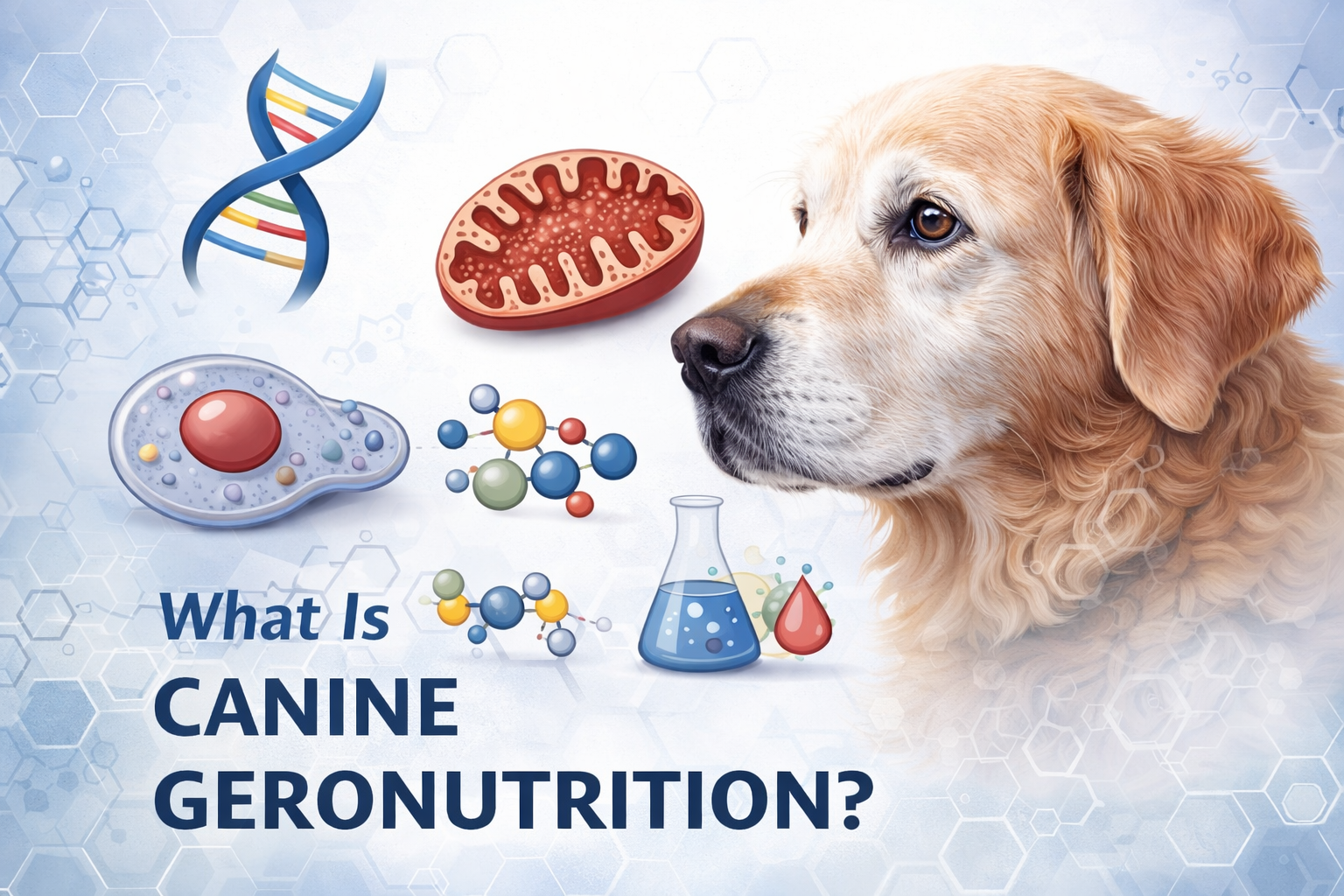

What Is Canine Geronutrition?
Aging in dogs is increasingly recognized not only as a chronological process, but as a biological phenomenon characterized by gradual changes in cellular maintenance, metabolic efficiency, and tissue resilience. As companion animals live longer due to advances in veterinary care and nutrition, attention has shifted toward understanding the biological mechanisms underlying age-related decline.
Canine geronutrition emerges at the intersection of aging biology and nutritional science. It does not propose to cure aging, nor does it equate nutritional strategies with pharmaceutical intervention. Rather, it seeks to examine how dietary components interact with biological processes associated with aging in companion animals.
Aging Versus Lifespan
It is important to distinguish between aging, lifespan, and healthspan.
Nutritional research in aging biology typically focuses on measurable biological parameters rather than lifespan extension. Changes in biomarkers may reflect shifts in physiological processes, but they do not independently demonstrate extended longevity.
Aging research therefore requires careful interpretation of endpoints and avoidance of over-extrapolation.
The Biological Context of Aging
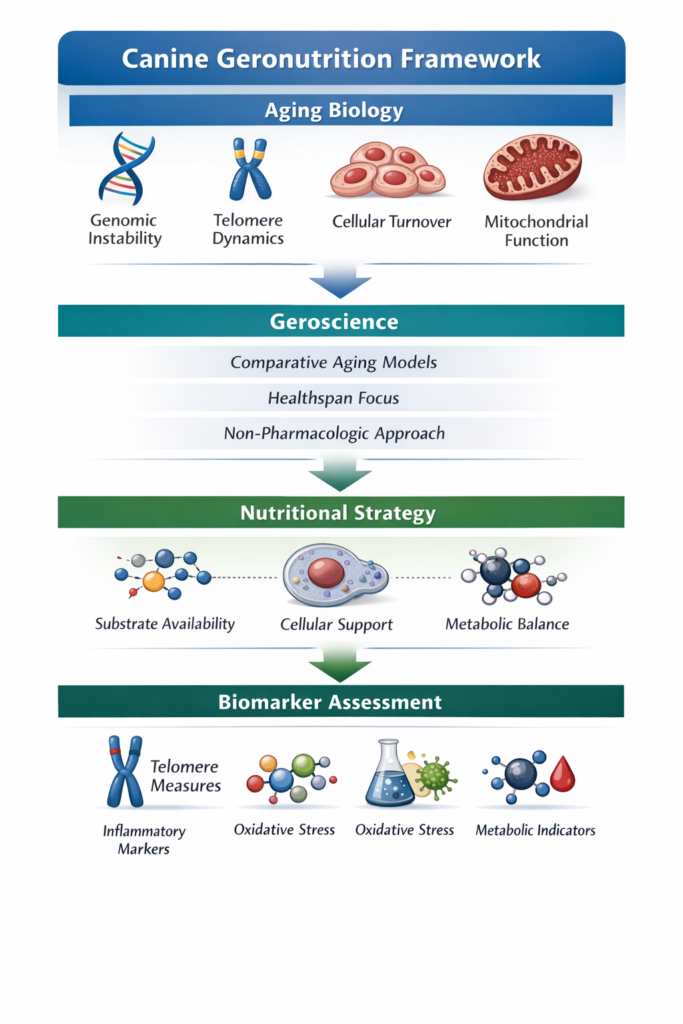
Across species, aging has been associated with several interrelated biological features:
-
These processes are studied in diverse organisms and provide a comparative framework for understanding aging in companion animals.
In dogs, as in other mammals, certain tissues exhibit continuous renewal. Immune cells, gastrointestinal epithelium, and skin undergo ongoing replication. These systems rely on coordinated metabolic pathways and nutrient availability to sustain normal function.
With advancing age, regulatory efficiency may shift. The magnitude and clinical implications of these changes vary between individuals and breeds.
Geroscience and Companion Animals
The field of geroscience seeks to understand how biological mechanisms of aging influence age-related functional decline. While much of this work has focused on humans and laboratory models, companion animals offer a unique comparative perspective.
Dogs share environmental exposures with humans, exhibit breed-specific variability in lifespan, and develop age-associated conditions analogous to those observed in people. This makes them an important model for translational aging research.
However, nutritional approaches within geroscience must be clearly distinguished from pharmacological strategies. Pharmaceutical interventions typically aim to modulate specific signaling pathways. Nutritional strategies, in contrast, emphasize substrate availability and physiological support.
Substrate Support in Aging Biology
Cells require coordinated nutrient supply to maintain DNA replication, RNA transcription, protein synthesis, and metabolic homeostasis. In high-turnover tissues, substrate availability plays a foundational role in maintaining normal cellular function.
Nutritional geroscience explores how dietary components interact with biological systems involved in cellular maintenance. This does not imply reversal of aging, nor does it override genetic determinants. Rather, it examines how physiological processes respond under defined dietary conditions.
Importantly, substrate support differs fundamentally from pathway modulation. Nutritional research evaluates biological response patterns under controlled contexts and interprets outcomes within experimental design parameters.
Geroscience and Companion Animals
Research in canine geronutrition often utilizes biomarkers to assess biological processes. These may include:
-
Biomarkers provide measurable signals within defined study conditions. They do not independently equate to lifespan extension, disease prevention, or clinical outcomes.
Scientific rigor requires distinguishing between association and causation, and between laboratory findings and real-world application.
Defining the Scope of Canine Geronutrition
Canine geronutrition is not a commercial category, nor a therapeutic claim. It is a conceptual framework for exploring how nutrition intersects with biological aging processes in companion animals.
The field rests on three guiding principles:
-
Advancing understanding in this area requires both curiosity and restraint.
Looking Forward
As aging biology continues to evolve, companion animals provide an important context for comparative research. Nutritional approaches may contribute to dialogue surrounding healthy aging, provided findings are interpreted responsibly and within appropriate scientific boundaries.
Canine geronutrition therefore represents an emerging interdisciplinary space — one that bridges molecular aging research, veterinary science, and nutritional biology without conflating their distinct roles.
Scientific progress depends not only on discovery, but on clarity of definition. Establishing that clarity is the first step.
These domains operate within distinct scientific and regulatory contexts.